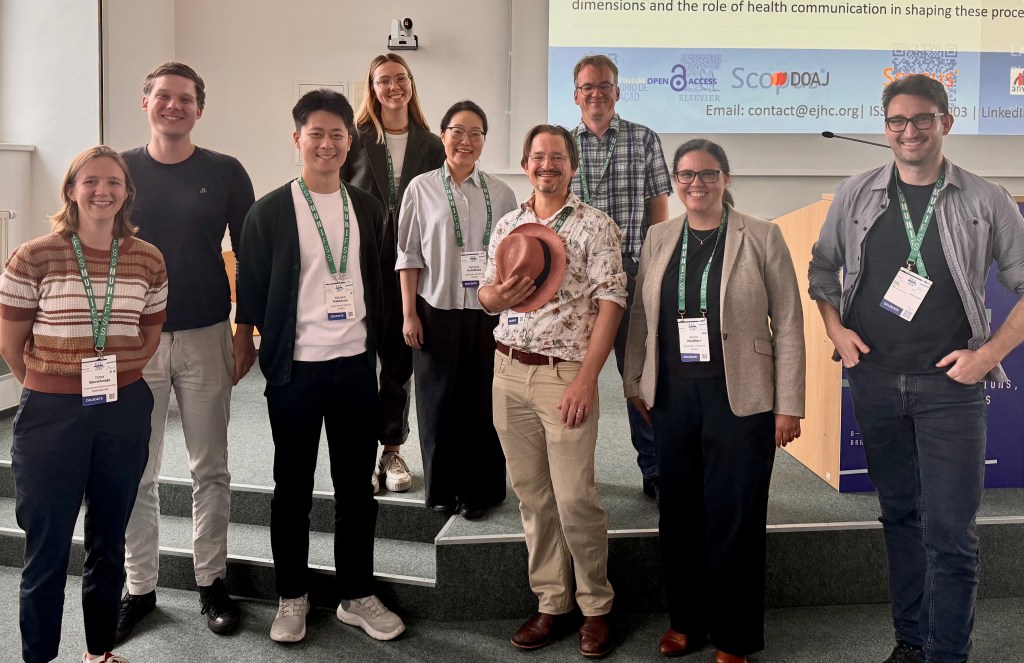
From 8 to 11 September 2026, hundreds of communication scholars from around the globe gathered in Brno, Czech Republic, for the 11th European Communication Conference (ECC2026). Hosted by Masaryk University’s Faculty of Social Studies, the conference brought together the scientific community under the theme “Shifting Grounds: Paths, Connections, and Futures.”
ECC2026 addressed how media and communication intersect with today’s critical global challenges. Scholars explored how diverse methods, innovative tools, and interdisciplinary solutions can help navigate issues like digital disruption, environmental crises, and geopolitical conflict, ensuring that research actively contributes to an inclusive and equitable future.
ECC2026 at a Glance
- 1,322 Speakers sharing cutting-edge research
- 1,342 Presentations across dozens of specialized tracks
- 22,401 Slides delivered over 4 days
Members of the WHAT-IF Consortium contributed to this major field event too. Armed with expertise in social simulation, agent-based modeling (ABM), and Large Language Models (LLMs), the WHAT-IF team delivered 7 presentations across 4 sessions and chaired 2 sessions, exchanging insights and shaping discussions with colleagues across the field.
Here is a look back at our main highlights from the conference.
ABMs for Policy Evidence in “The Promise and Limits of DSA Implementation”
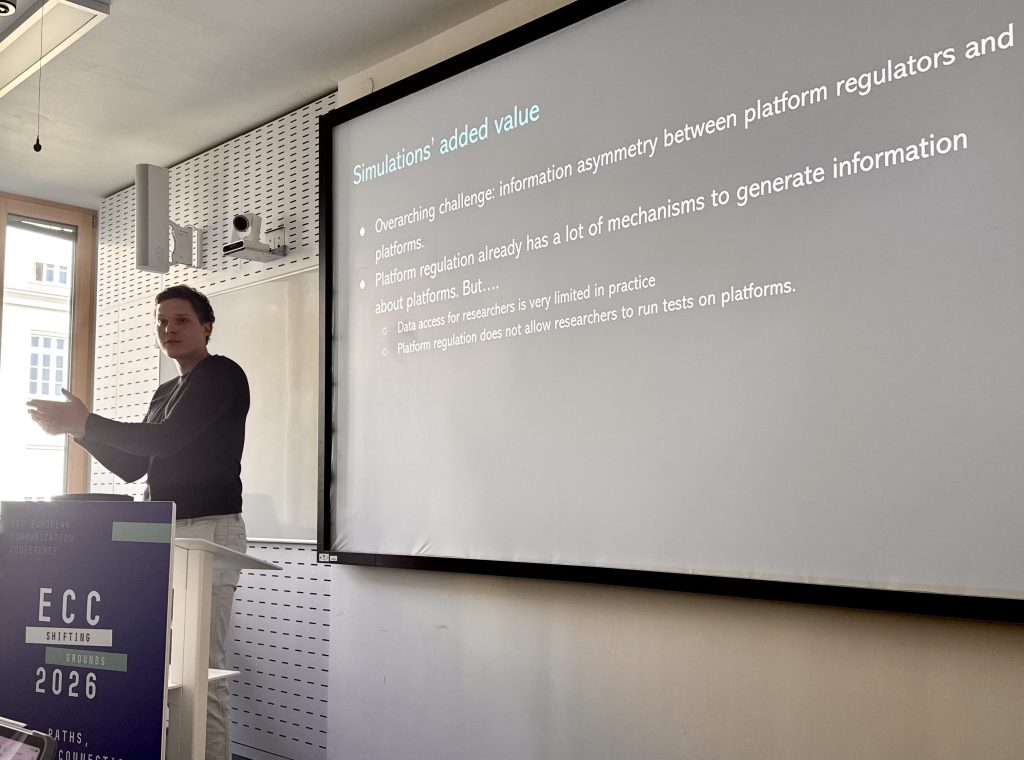
During a session examining platform regulation under the Digital Services Act (DSA), legal and policy scholars explored practical challenges in governance. Max van Drunen presented findings from a collaborative study with WHAT-IF colleagues Natali Helberger, Aytalina Kulichkina, and Annie Waldherr. Their work investigates how Agent-Based Models can be applied to support evidence-based policymaking in platform governance.
📖 Pre-print: https://osf.io/preprints/socarxiv/y2ext_v1
Game-Theoretic Experiments with LLMs in Human-AI Communication
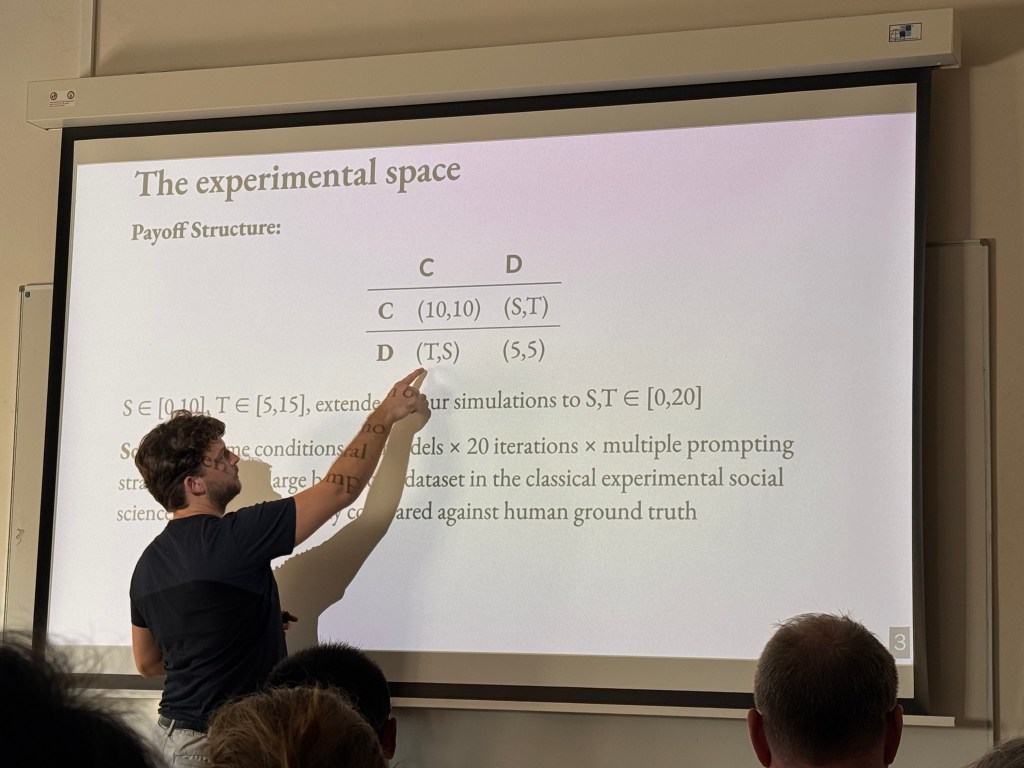
In the Human-AI Communication session, chaired by WHAT-IF consortium member Rupert Kiddle, Max Pellert presented a paper titled “Using large language models as digital twins to replicate and extend game-theoretic experiments on human cooperation”
Written in collaboration with Andrea Cera Palatsi, Samuel Martín Gutiérrez, and Ana S. Cardenal, the study examines whether LLMs can reliably predict and replicate human cooperation patterns within game theory contexts.
📖 Pre-print: https://arxiv.org/abs/2511.04500
Scoping the Landscape of Social Media Simulations
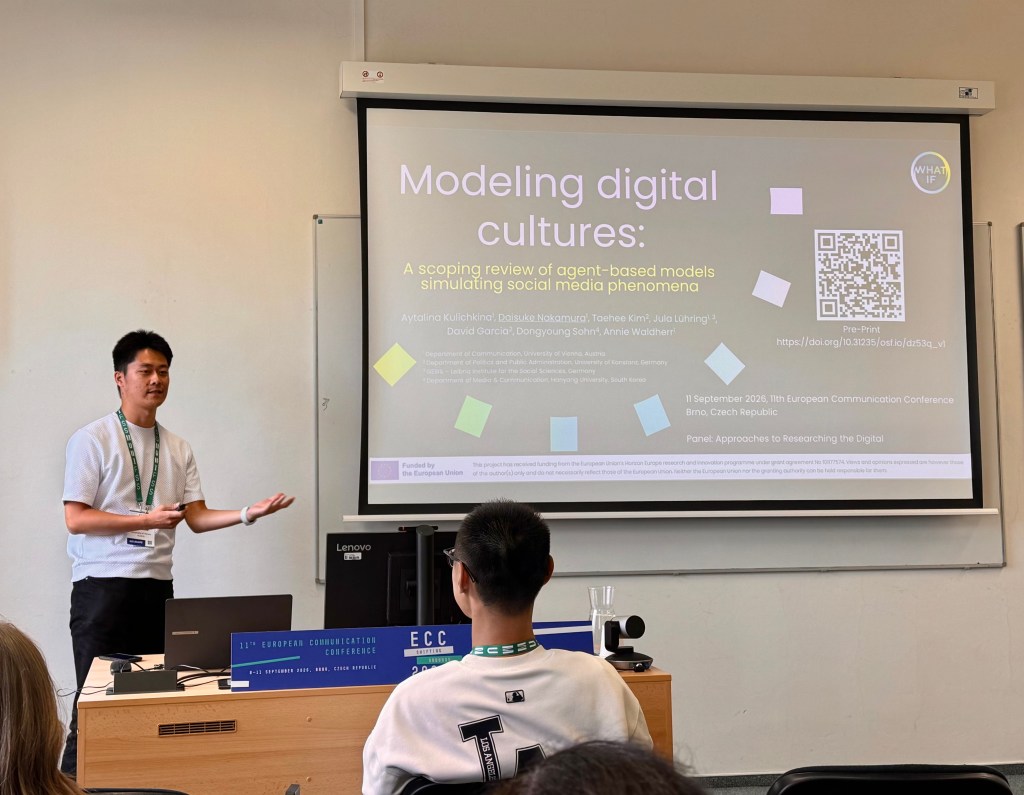
In the Approaches to Researching the Digital session, Daisuke Nakamura presented “Modeling digital cultures: A scoping review of agent-based models simulating social media phenomena.” Co-authored by Aytalina Kulichkina, Daisuke Nakamura, Taehee Kim, Jula Lühring, David Garcia, Dongyoung Sohn, and Annie Waldherr, the study systematically reviews 196 papers to examine how agent-based models simulate social media dynamics, highlighting a key opportunity for social scientists to integrate core communication theories into future simulation models.
📖 Pre-print: https://osf.io/preprints/socarxiv/dz53q_v1
WHAT-IF Session: “Modeling Digital Communication Futures: LLMs and ABMs”
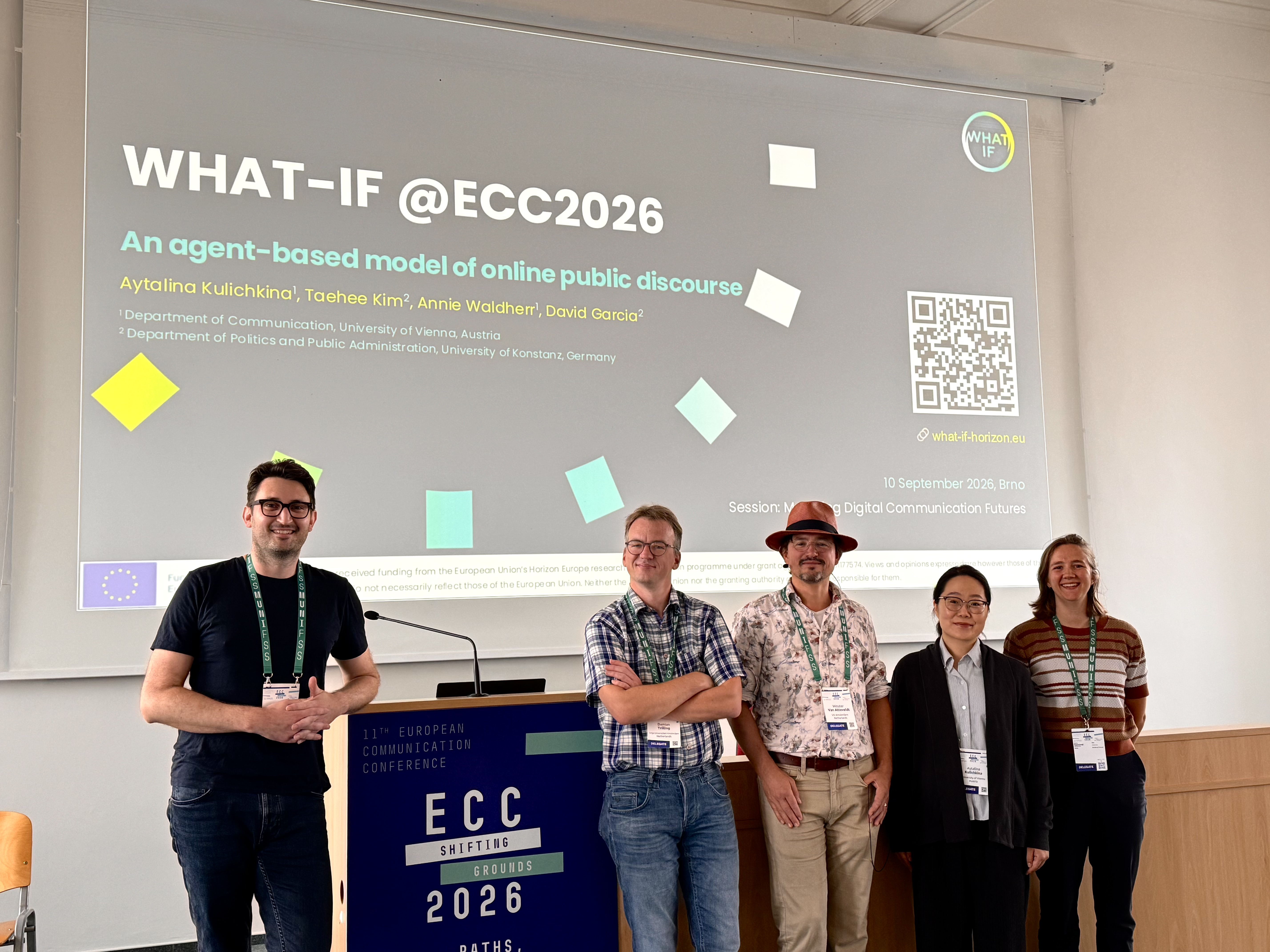
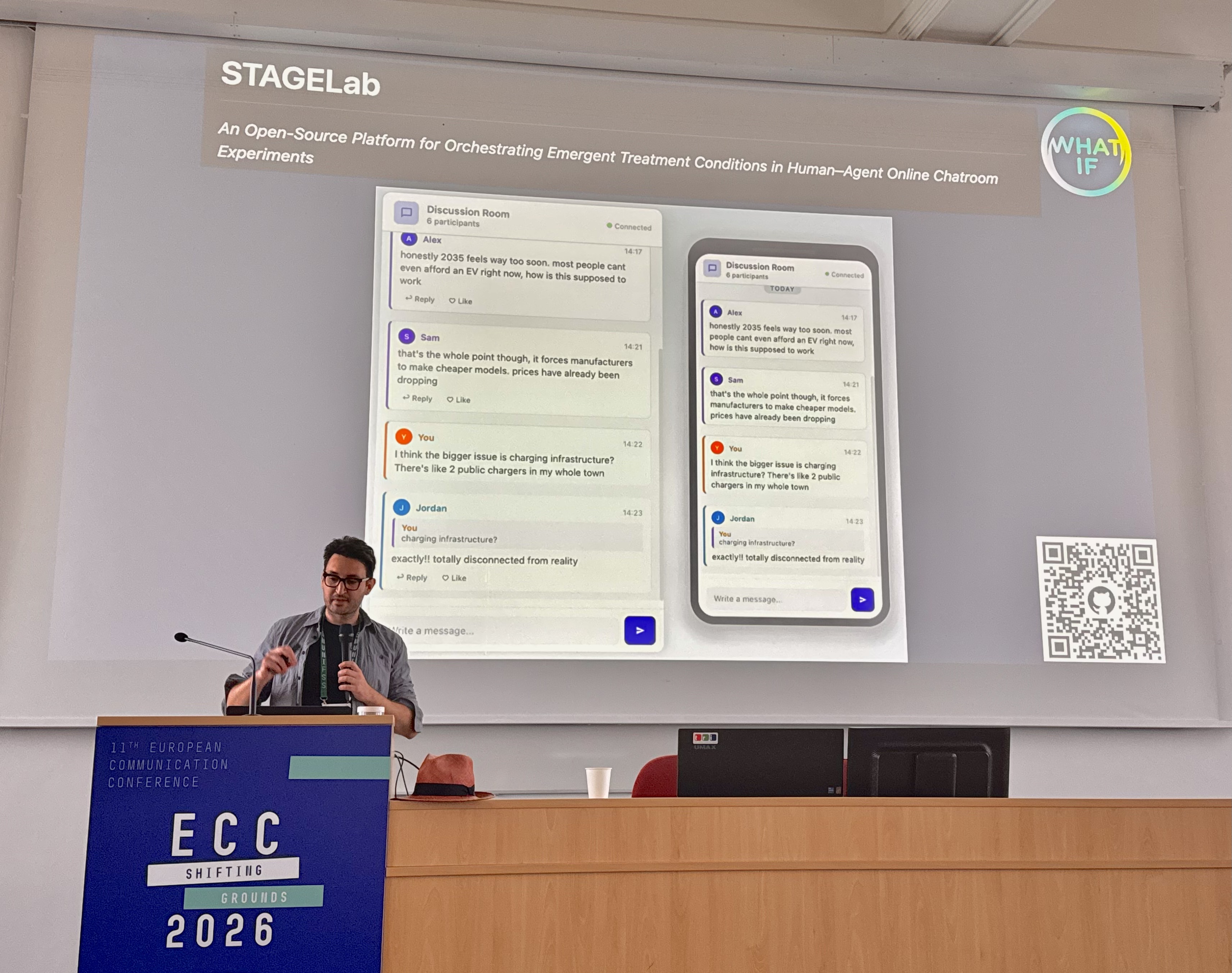
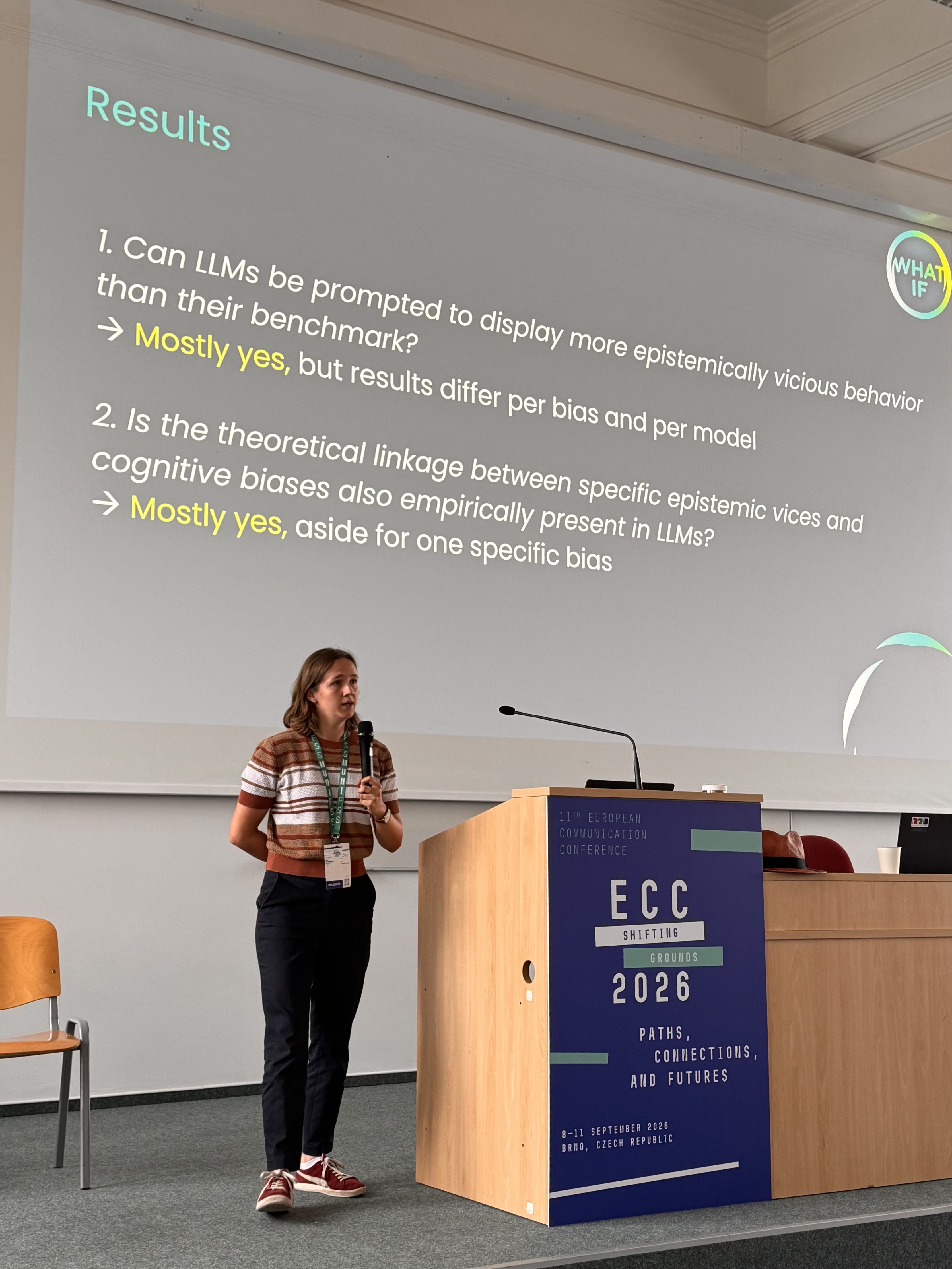
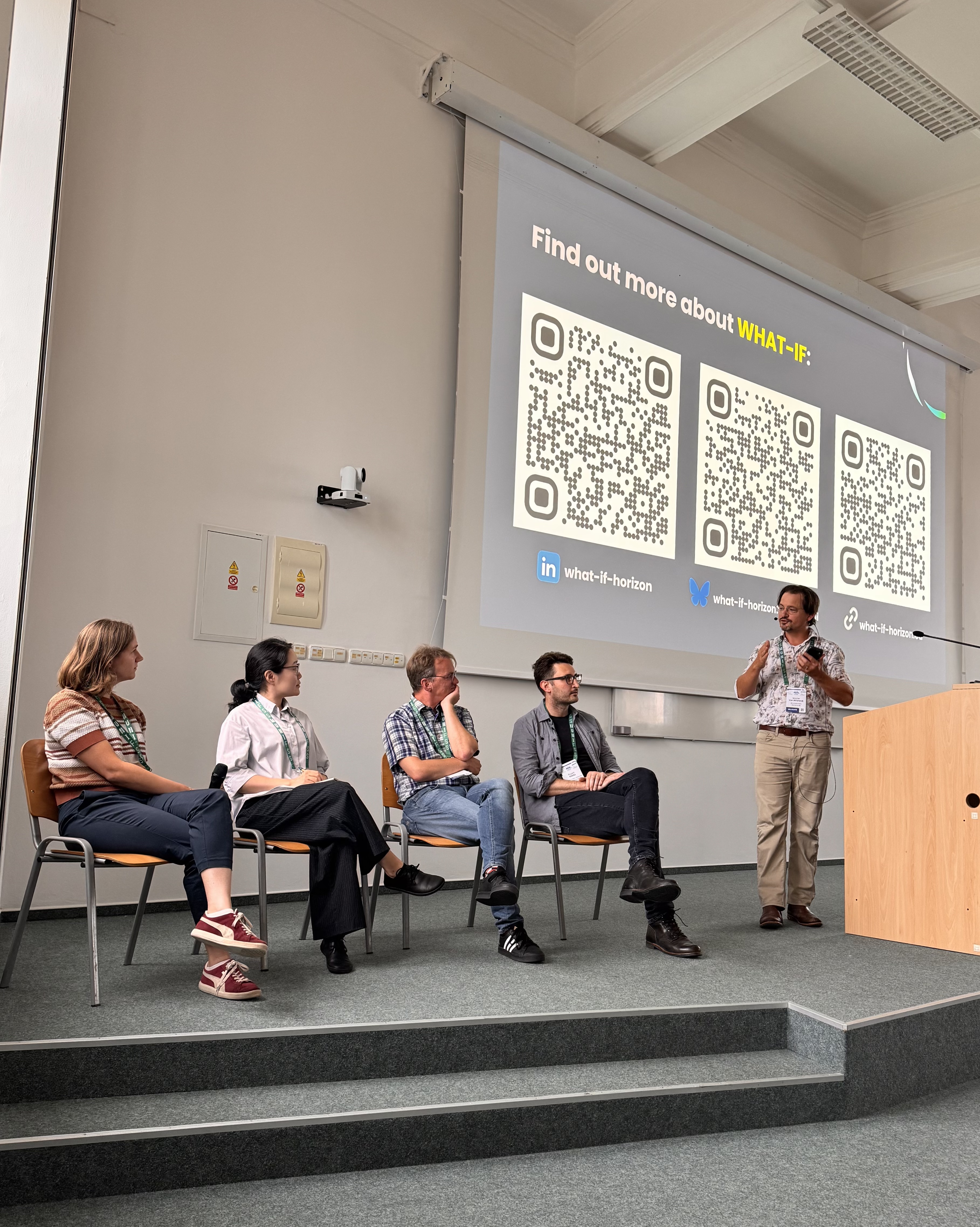
Organized by Aytalina Kulichkina and chaired by Wouter van Atteveldt, the session featured state-of-the-field presentations and a dynamic roundtable discussion. Aytalina Kulichkina, Rupert Kiddle, and Dana Bouwknegt presented progress and open questions from the WHAT-IF project, while Damian Trilling highlighted key outcomes from the recently completed TWON Project.
Acknowledgments & Gratitude
ECC2026 was a truly inspiring experience. Over four packed days in Brno, our team gained valuable research insights, exchanged ideas with international colleagues, and participated in numerous thoughtful discussions across sessions and roundtables.
We extend our sincere gratitude to the Faculty of Social Studies at Masaryk University for their exceptional hospitality, as well as to ECREA for organizing such an impactful event. Thank you to all the session chairs, discussants, and participants who attended our presentations and engaged with our work.
We look forward to reconnecting with everyone and continuing these conversations at ECC2028 in Vilnius, Lithuania!