
Dear WHAT-IF members and network,
July is coming to an end, which means it is time to look back at everything that has happened in our project over the past few months. In this newsletter, we highlight some of the most important moments and accomplishments from the recent period.
Conferences
COMPTEXT 2026 (Birmingham, UK)
The COMPTEXT 2026 Conference is an international venue for researchers applying computational methods to analyse text, audio, and video data across the social sciences and humanities.
Constantine Boussalis presented there the paper “Climate Persuasion Dynamics in Generative Agent Populations,” co-authored by Travis Coan, Ranadheer Malla and Max Pellert. The study explores whether LLM-based “digital twins” can be developed using existing survey data as an alternative to the costly qualitative interviews often required for building such simulations. These AI-based agents were tested in simulated Reddit-style climate discussions, examining how different compositions of participants and discussion topics influence changes in climate-related attitudes over time. The results suggest that even in simulated environments, conversational dynamics can shape opinion shifts and framing patterns, highlighting the potential of generative agent models for testing communication strategies before applying them in real-world settings.
EPSS 2026 (Belfast, UK)
The inaugural European Political Science Society (EPSS) Conference 2026 provided a platform for researchers from across Europe to exchange ideas and present innovative work in political science.
Georgia Dagher presented there the paper “Ideological Biases and Motivations in Identifying and Moderating Misinformation,” co-authored by Auksė Balčytienė, Ana Sofia Cardenal, Silvia Majó-Vázquez, Mariken van der Velden, Laia Castro, Paula Szewach, Wouter van Atteveldt, and Andreu Casas.
The study investigates how ideological alignment influences people’s ability to identify misinformation and their willingness to moderate content on social media. The preliminary analysis presented at the conference draws on survey data from Spain and the Netherlands, examining how users evaluate true and false claims related to immigration and climate change, as well as how political viewpoints shape moderation decisions.
The conference presentation was based on a preliminary research draft. The full paper is currently in preparation, as data collection in Romania and Lithuania is still ongoing.
ICA 2026 (Cape Town, South Africa)
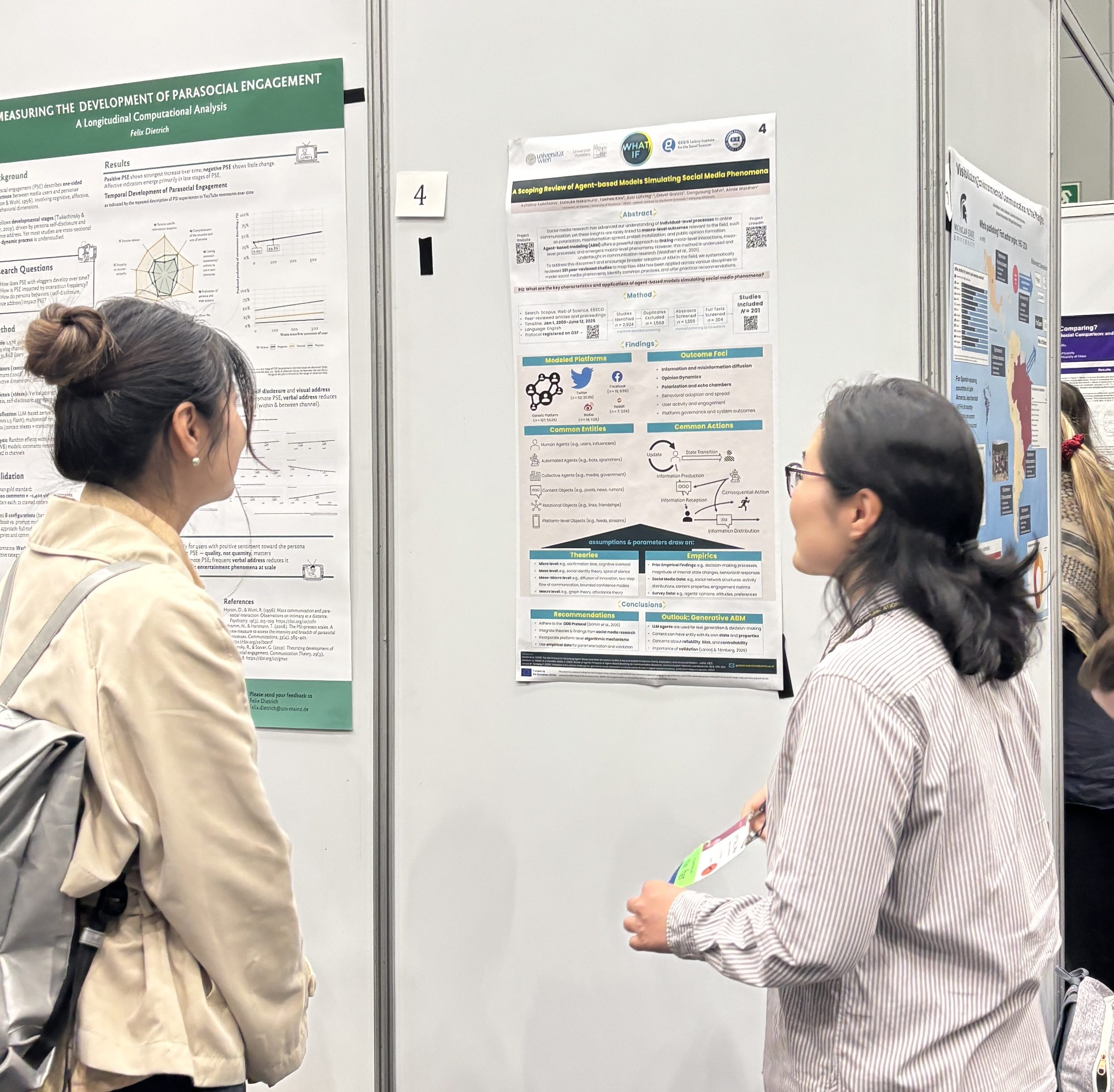
The 76th Annual Conference of the International Communication Association (ICA), the world’s largest academic association dedicated to communication research. Members of the WHAT-IF project contributed to the conference with three presentations showcasing the project’s work on agent-based modeling (ABM) of social media.
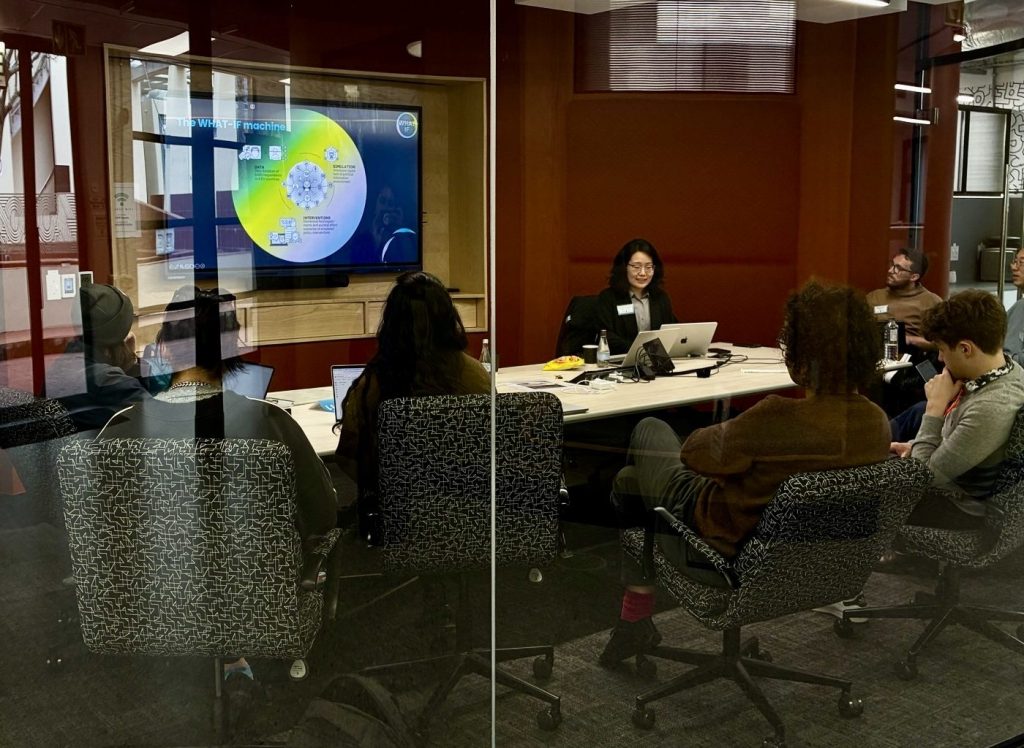
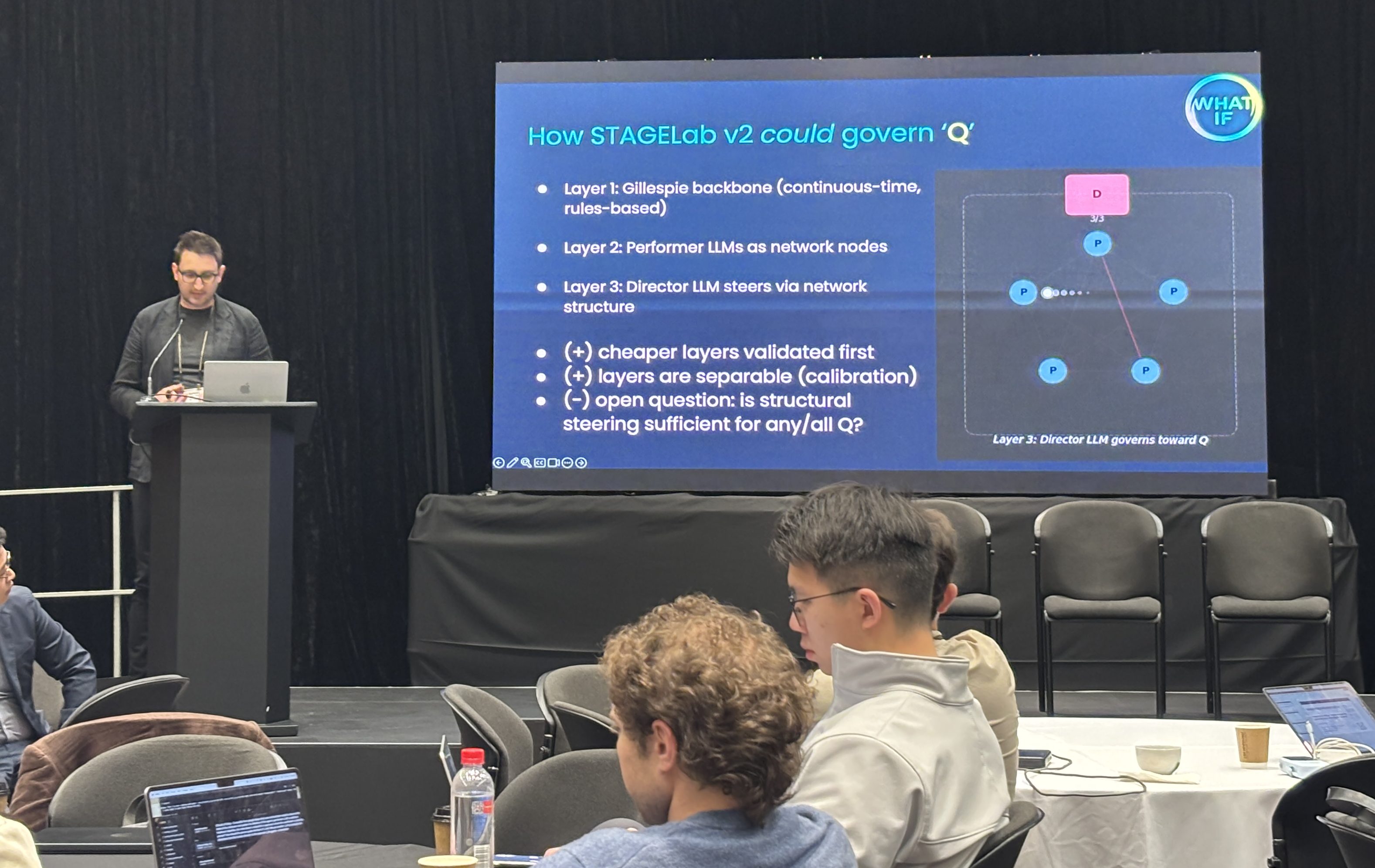
Also at ICA 2026, Rupert Kiddle and Wouter van Atteveldt presented the paper “STAGELab: An Open-Source Platform for Orchestrating Emergent Treatment Conditions in Human–Agent Online Chatroom Experiments” during the “HIGH-DENSITY: On the Frontier of AI Social Simulation” session.
PolMeth Europe 2026 (Dublin, Ireland)
The PolMeth Europe 2026 Conference brought together researchers from across Europe interested in innovative approaches to political methodology. The conference featured presentations of methodological contributions and empirical studies applying advanced research methods to a wide range of questions across political science.
As part of the “Online Politics” panel, Aytalina Kulichkina presented the WHAT-IF project’s research titled “An Agent-Based Model of Online Deliberation and Contention.” The presentation highlighted the advantages of ABM for studying online deliberation processes and introduced the project’s baseline simulation model. Aytalina also shared ongoing developments, including the integration of empirical data and LLMs into the simulation framework. While the research is still in progress, the baseline model is already available in NetLogo and Python.
2nd Annual Meeting of the Institutions, Politics, and Economics Research Center (Barcelona, Spain)
The meeting brought together members of the Institutions and Political Economy Research Center, including young researchers, PhD students and also more senior members in political economy, economic history and political science with experimental and/or causal approaches to these issues, to present and discuss their ongoing research.
Martín García Ortiz presented there the paper “Voice, Correction, and Exit as Responses to Online Incivility: Insights from an Experiment in a Simulated Social Media Environment.” The presentation introduced the WHAT-IF project’s WP5 pilot platform, a simulated social media environment designed to study how users respond to online incivility through different behavioural strategies. It also showcased the platform’s underlying STAGE framework, including its approach to treatment assignment, AI-agent composition, realism features, and data collection tools, highlighting the project’s progress toward a deployable experimental environment.
New preprints
In recent months, the WHAT-IF consortium has shared several new preprints, offering a first look at the latest research insights and developments emerging from the project.
“Agent-based models of social media: A scoping review and research agenda”
- Authors: Aytalina Kulichkina, Daisuke Nakamura, Taehee Kim, Jula Lühring, David Garcia, Dongyoung Sohn, Annie Waldherr
- Short description: The paper presents a systematic review of how ABM has been applied to study social media phenomena across different disciplines. It highlights the potential of ABM to connect individual-level online interactions with macro-level processes such as polarization, misinformation spread, and public opinion formation. The study identifies current methodological practices, research gaps, and opportunities for developing more theoretically grounded and transparent models in computational social media research.
- Link: https://doi.org/10.31235/osf.io/dz53q_v1
“Large language models replicate and predict human cooperation across experiments in game theory”
- Authors: Andrea Cera Palatsi, Samuel Martin-Gutierrez, Ana Sofia Cardenal, Max Pellert
- Short description: The study explores whether large language models (LLMs) can reliably replicate human decision-making in strategic social interactions. By comparing the behaviour of three open-source LLMs with results from large-scale game-theoretic experiments, it was found that some models closely reproduce human cooperation patterns while others behave more in line with theoretical predictions. The findings demonstrate the potential of LLMs as realistic agents for social simulation and provide new opportunities to explore human decision-making in experimental settings that have not yet been tested with human participants.
- Link: https://doi.org/10.48550/arXiv.2511.04500
“Using agent-based simulations to anticipate risks and mitigation measures in platform governance”
- Authors: Max van Drunen, Natali Helberger, Aytalina Kulichkina, Annie Waldherr
- Short description: The paper explores the potential of ABM as a tool to support platform governance and risk assessment. It examines how simulations can help researchers and regulators test possible changes to digital platforms in a more ethical and independent way, overcoming challenges related to real-world experimentation and data access. Based on a theoretical framework and interviews with 18 regulators, the study highlights the opportunities and limitations of using ABM to inform evidence-based decision-making and explore possible future scenarios for platform governance.
- Link: https://osf.io/preprints/socarxiv/y2ext_v1
New publications
Alongside ongoing research shared through preprints, one WHAT-IF paper has recently been published in a peer-reviewed journal.
“The collective turing test: large language models can generate realistic multi-user discussions”
- Authors: Azza Bouleimen, Giordano De Marzo, Taehee Kim, Nicolò Pagan, Hannah Metzler, Silvia Giordano, Anikó Hannák, David Garcia
- Journal: Scientific Reports (Early Access)
- Short description: The paper investigates whether LLMs can realistically simulate human conversations in online communities. By comparing authentic Reddit discussions with AI-generated conversations created by Llama 3 70B and GPT-4o, the study examines how easily people can distinguish between human- and AI-generated content. The findings show that LLM-generated discussions can appear highly convincing, highlighting both the potential of AI-based social simulations for research and the risks associated with creating inauthentic online content.
- Link: https://www.nature.com/articles/s41598-026-62286-9
Dataverse
The BSC Dataverse is now fully operational, and the dedicated WHAT-IF Dataverse Collection has been established to host and share the project’s research outputs.
Link: https://dataverse.bsc.es/dataverse/what-if
Following the completion of the data collection process, the repository will provide access to data donations collected from Instagram, X, YouTube, TikTok, and Facebook across four European countries (Romania, Lithuania, the Netherlands, and Spain) as well as additional datasets and research materials generated throughout the WHAT-IF project.
WHAT-IF in University of Vienna’s Rudolphina Science Magazine
The Rudolphina Science Magazine of the University of Vienna featured the WHAT-IF project in an article exploring how ABM and LLM-powered simulations can help researchers understand and protect democratic discourse in digital information environments. Annie Waldherr, Professor of Computational Communication Science at the Department of Communication at the University of Vienna, and Aytalina Kulichkina, postdoctoral researcher at the Department of Communication at the University of Vienna, highlight in the article how the WHAT-IF team uses computational simulations to study the influence of social media, algorithms, and AI on online communication, including processes such as polarization, misinformation spread, and civic engagement.
For more insights you can read the whole article here.
The 2nd WHAT-IF General Assembly Meeting in Bucharest
On 25–26 June 2026, the WHAT-IF consortium gathered in Bucharest, Romania, for its 2nd General Assembly Meeting, hosted by the National University of Political Studies and Public Administration (SNSPA). Representatives from all partner institutions met to discuss project progress, exchange research insights, and coordinate the next steps of the project.
During the meeting, partners shared updates on ongoing activities across all work packages, including data collection, ABM simulations, experiments on opinion dynamics, policy applications, and upcoming dissemination activities. The General Assembly also featured a guest lecture by Professor Alina Bârgăoanu on the impact of algorithms and digital platforms on contemporary information environments, as well as Research Talks presenting ongoing studies on misinformation, social media, and platform governance.
More about the Assembly you can find in our previous website-post.
Upcoming conference presentations
Social Simulation Conference 2026 (ESSA) | August 24-28, 2026 | Durham, UK
- Kulichkina, A., Kim, T., Waldherr, A., & Garcia, D. (2026, August 25). An agent-based model of online public discourse [Poster presentation]. Social Simulation Conference 2026, Poster Session and Welcome Drinks Reception.
- Kulichkina, A., Nakamura, D., Kim, T., Lühring, J., Garcia, D., Sohn, D., & Waldherr, A. (2026, August 26). Agent-based models of social media: A scoping review and research agenda [Conference presentation]. Social Simulation Conference 2026, Session: Agent-Based Models with Social Networks.
- van Drunen, M., Helberger, N., Kulichkina, A., & Waldherr, A. (2026, August 26). Using ABM to inform platform regulators [Conference presentation]. Social Simulation Conference 2026, Session: Agent-Based Models with Social Networks.
European Communication Conference (ECREA ECC2026) | September 8-11, 2026 | Brno, Czech Republic
- Bouwknegt, D., van Atteveldt, W., Kiddle, R., & Ruigrok, N. (2026, September 11). Epistemically vicious LLMs: Influencing the exhibition of epistemic vices in Large Language Models [Conference presentation]. European Communication Conference (ECREA ECC2026), Session: Modeling Digital Communication Futures: Large Language Models and Agent-Based Simulations.
- Kiddle, R. T. (2026, September 11). Designing for immersion: Surveying frameworks for LLM-based social agents in human-participant experiments [Conference presentation]. European Communication Conference (ECREA ECC2026), Session: Modeling Digital Communication Futures: Large Language Models and Agent-Based Simulations.
- Kim, T., Garcia, D., & De Marzo, G. (2026, September 11). From timelines to agents: Evaluating the behavioral fidelity of LLM-based agents for social media simulation [Conference presentation]. European Communication Conference (ECREA ECC2026), Session: Modeling Digital Communication Futures: Large Language Models and Agent-Based Simulations.
- Kulichkina, A. (2026, September 11). An agent-based model of online public discourse [Conference presentation]. European Communication Conference (ECREA ECC2026), Session: Modeling Digital Communication Futures: Large Language Models and Agent-Based Simulations.
- Trilling, D. (2026, September 11). Between control and realism: Learnings from a three-year project [Conference presentation]. European Communication Conference (ECREA ECC2026), Session: Modeling Digital Communication Futures: Large Language Models and Agent-Based Simulations.
- Pellert, M. (2026, September 9). Using large language models as digital twins to replicate and extend game-theoretic experiments on human cooperation [Conference presentation]. European Communication Conference (ECREA ECC2026), Session: Human-AI communication.
- Kulichkina, A. (2026, September 11). Modeling digital cultures: A scoping review of agent-based models simulating social media phenomena [Conference presentation]. European Communication Conference (ECREA ECC2026), Session: Approaches to Researching the Digital.
- van Drunen, M. Z. (2026, September 9). Governing under uncertainty: Simulating risks and interventions in platform governance [Conference presentation]. European Communication Conference (ECREA ECC2026), Session: The Promise and Limits of Digital Services Act Implementation.
Data Donation Symposium 2026 | October 1-2, 2026 | Berlin, Germany
- Vischer, N., et al. (2026, October 1–2). Unfolding the map to social media data: Evaluating the completeness and transparency of data download packages [Conference presentation]. 5th Data Donation Symposium, Berlin, Germany.
Please forward this newsletter to your team members or colleagues interested in our project.
The newsletter serves as a platform to share updates on our research presentations, announce upcoming events and publications, and keep everyone connected with our latest work. We’ll continue sending these updates to subscribers and publishing them on our website every three months.
 WHAT-IF