
On 25–26 June 2026, the WHAT-IF consortium gathered in Bucharest, Romania, for its 2nd General Assembly Meeting, hosted by the National University of Political Studies and Public Administration (SNSPA). The meeting brought together representatives from all partner institutions to review the progress achieved across the project’s work packages, share preliminary findings, exchange methodological approaches, and discuss the next stages of the research.
Current Progress Across the Work Packages
During the General Assembly, each work package presented updates on its ongoing activities.
Data Management & Collection. Data collection is progressing steadily across the participating countries. Survey, browsing, and Social Media Takeout data have already been collected or partially collected in Spain, the Netherlands, and Romania, while data collection in Lithuania is ongoing. The consortium also discussed strategies for publishing these datasets.
Modelling & Simulation. Development of the WHAT-IF simulation framework continued to advance, with researchers refining the project’s agent-based models (ABM) and exploring new “WHAT-IF” scenarios to better understand how user behaviour, content characteristics, and platform dynamics shape online information environments.
Interventions. WP5 is preparing a series of field experiments to investigate how people respond to different online information environments. The experiments will focus on three key aspects of today’s digital media landscape: online (in)civility, disinformation, and exposure to more or less homogeneous political viewpoints. The results will help to validate and refine the simulation environment being developed by the WP4 team.
Policy. WP6 shared updates on its ongoing work exploring the potential of ABMs to support policy and platform governance. General overview of how and under what conditions ABM can effectively support platform governance is already available in the preprint: “Towards Responsible Platform Governance: The Role of Agent-Based Models in Platform Regulation”. Further tests, discussions and recommendations are in process.
Engagement and Dissemination. An important focus of the WHAT-IF project is ensuring that research outcomes are shared with and accessible to a wide range of stakeholders. So members of WP8, representing both academic institutions and NGOs such as Internews and EAVI, presented updates on the preparation of upcoming dissemination and engagement activities. These include conferences, workshops, and round tables developed in close collaboration with other WPs. The closest event is happening in October.
Note: Updates and access links to all the activities mentioned above will be shared through the project’s media as they become available, so follow up on LinkedIn and BlueSky and stay tuned!
Guest Lecture
In addition to the consortium discussions, the 2nd General Assembly featured a guest lecture by Professor Alina Bârgăoanu titled “Ways Forward for Researching Information Ecosystems under Conditions of Algorithmic Mediation.”
The lecture offered valuable perspectives on the evolving nature of today’s digital media environment. Professor Bârgăoanu explored how rapid technological advances, the increasing concentration of digital and data power, and the growing interconnectedness of online platforms are reshaping public life and the way information is produced, distributed, and consumed.
A key message of the presentation was that social media should not be viewed simply as traditional media with interactive features. Instead, it represents a fundamentally different information ecosystem, shaped by algorithmic curation, platform architectures, and embedded biases. The lecture provided an inspiring foundation for discussions on the challenges and opportunities of researching contemporary information ecosystems.
Research Talks
Research Talks were another important component of the General Assembly, providing a space for partners to present and discuss their ongoing research activities. Consortium members shared research designs and ideas covering a wide range of topics, including misinformation, social media data transparency, challenges of data donation, opinion environments, incivility on social media, and platform governance.
Plenary Sessions
Open discussions were an important part of the 2nd WHAT-IF General Assembly, providing an opportunity for consortium members to reflect on the project’s broader impacts and future directions. Partners exchanged ideas on how to communicate the project’s outcomes to wider audiences and discussed ways to connect current research findings with the overall aims and objectives of WHAT-IF.
Many thanks to Facultatea de Comunicare si Relatii Publice for the excellent organisation and hospitality, and to the city of Bucharest for the welcoming atmosphere. These two days were filled with collaboration, engaging discussions, and forward-looking ideas. Many thanks to all consortium members who joined the meeting for their valuable contributions and active participation in advancing the goals of the WHAT-IF project.
The work continues, and exciting results are on the horizon. Stay tuned for upcoming project updates and achievements!
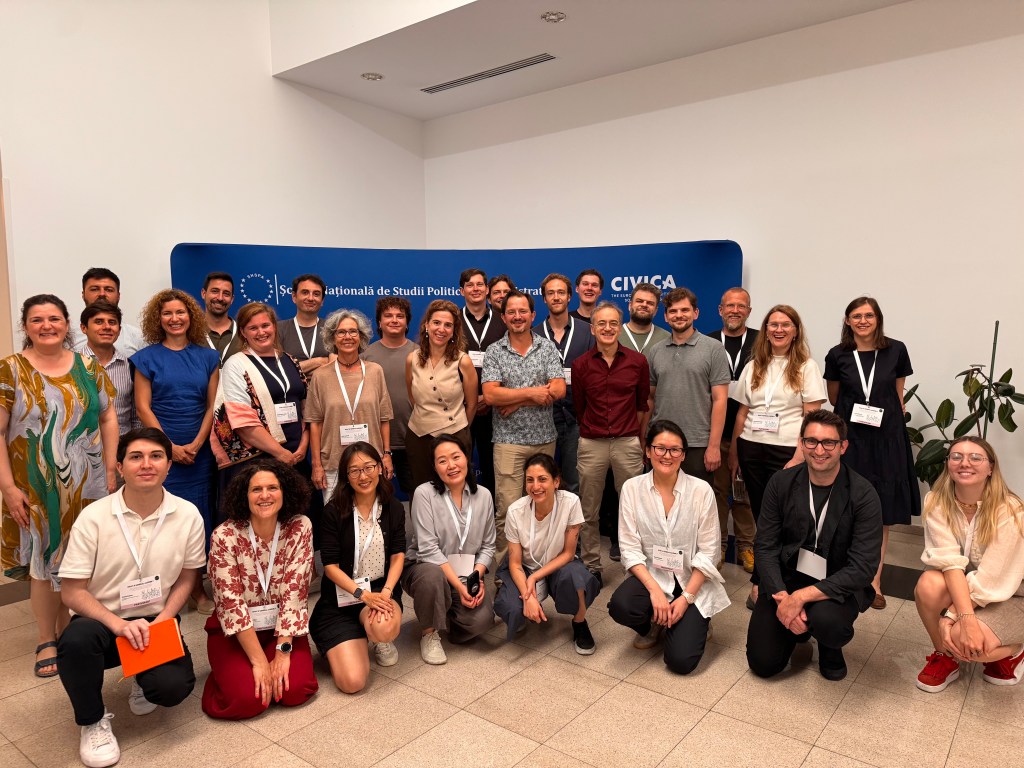
(lower row) Semih Solmaz (EAVI), Stefania Milan (EUI), Taehee Kim (UKON), Aytalina Kulichkina (UNIVIE), Georgia Dagher (RHUL), Aijan Kunneman (VUA), Rupert Kiddle (VUA), Yauheniya Khryshchanovich (UNIVIE)
(upper row) Nicoleta Corbu (SNSPA), Paolo Marangio (BSC), Andreu Rodilla Lazaro (BSC), Madalina Botan (SNSPA), Andreu Casas (Oxford), Mariken van der Velden (VUA), Constantine Boussalis (TCD), Ana Sofia Cardinal (FUOC), Martin Garcia Ortiz (BSC), Silvia Majo Vazquez (VUA), Robertas Tamosauskas (Internews), Max Pellert (BSC), Wouter van Atteveldt (VUA), Bernard Morsink (EUI), Max van Drunen (UvA), Paolo Celot (EAVI), David Garcia (UKON), Dainius Dauksa (VMU), Hajo Boomgaarden (UNIVIE), Asta Zelenkauskaite (VTech), Andreea Stancea (SNSPA)

