

Dear WHAT-IF members and network,
Spring is in full swing and so is the WHAT-IF team! This newsletter brings you first insights on misinformation detection and interventions, plus an overview of conference presentations in the coming months.
New WHAT-IF studies presented at the Political Science Association Conference in Oxford
In March, the WHAT-IF researchers Georgia Dagher and Sílvia Majó-Vázquez presented two working papers at the PSA26 Annual Conference celebrated in Oxford. The studies were part of a conference panel focused on mapping misinformation across countries and included other presentations looking at the same phenomena in Russia, Mexico the US and the UK. The panel itself gathered significant attention with a full room of researchers interested in the topic and prompted an interesting debate on measurement instruments and conceptualizations. The WHAT-IF studies are led by Andreu Casas and part of WP3. The main take away messages are summarized below:
Ideological Biases and Motivations in Identifying and Moderating Misinformation
In this pre-registered study, the researchers identified the conditions under which social media users correctly identify false versus true information and their willingness to moderate such content (3,900 participants from Spain and the Netherlands). Importantly, while people could tell true claims from false ones, on average, their assessments were often biased by their views and they were more likely to question a claim when it clashed with their attitudes. In addition, only few participants would report or flag content online that they rated as false, and they would be more likely to do so if the claim was against their attitudes. These findings are especially relevant to ongoing debates among platforms and EU regulators on replacing professional fact-checkers with community notes systems for detecting online mis- and disinformation.
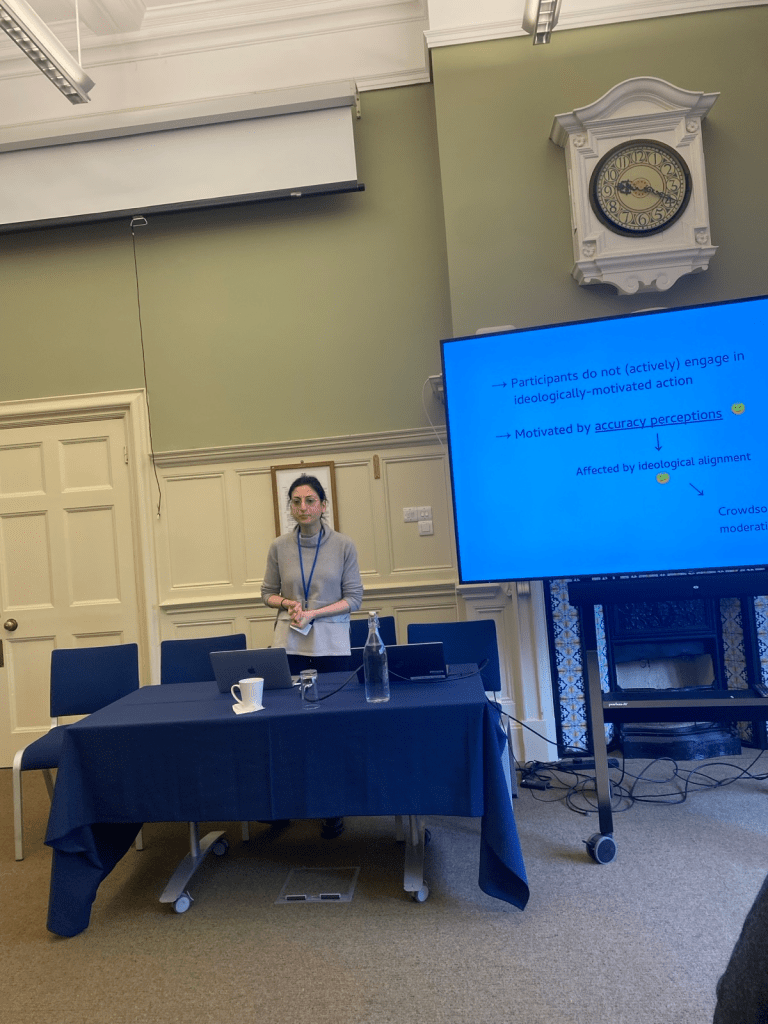
Georgia Dagher presenting the first results of a WHAT-IF study at the PSA26 Annual Conference in Oxford
Comparing High-Quality News Boost against Standard Misinformation Inoculation Interventions
In another study included between the two waves of the panel survey in Spain, researchers tested the positive but also the potential negative effects of a set of strategies designed to improve people’s ability to discern between true and false information online, by directing participants to a fact-checking, a digital literacy, or a high-quality news website over four weeks. The websites were maintained in a partnership with the leading fact-checking organization Maldita.es and digital literacy organisation LearnToCheck in Spain (see a blog post on this partnership here) as well as with the collaboration with the legacy news media outlets El País and El Mundo. The results show that participants engaging with fact-checking or digital literacy organisations improved their ability to identify false news and exposing them to this content did not make them more skeptical of true news. This represents good news and importantly, illustrate a path forward for new strategies to combat misinformation. Additionally, the study also point to the non-significant effects of boosting quality news consumption on participants, a finding that the researchers will look more into in the coming months.
Sílvia Majó-Vázquez introducing a WHAT-IF working paper on misinformation inoculation interventions
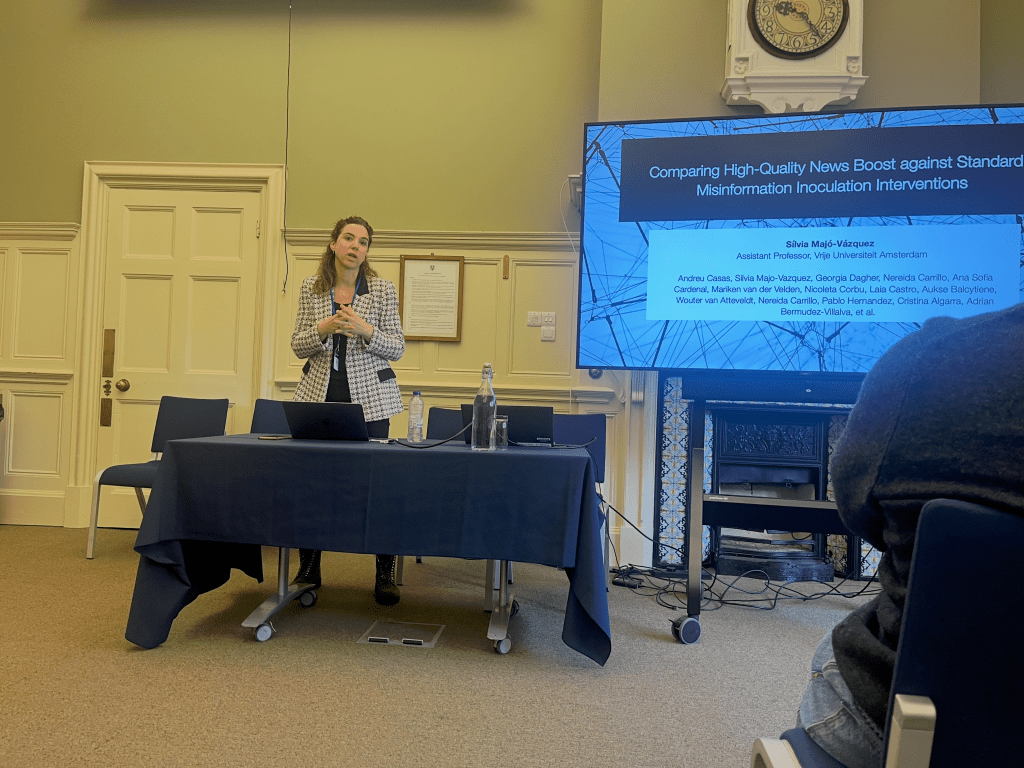
We’re looking forward to hearing more about this soon!
Evaluating LLM-based agents for social media simulation
In February, our colleague Taehee Kim from WP4 was invited to give a guest talk at the University of Saarland, as part of the talk series Soziologie Schwerpunkt Europa. Here is the abstract:
Simulating social media users with generative agents has emerged as a promising methodological approach to studzing social media dynamics, including information diffusion and opinion formation (Gao et al., 2024; Park et al., 2023; Törnberg et al., 2023). Such simulations allow researchers to explore counterfactual scenarios, scale empirical analyes, and reduce reliance on costly or incomplete behavioral data. However, the validity of such approaches hinges on a critical yet under explored question: to what extent can LLM-based agents faithfully replicate real users’ attitudes and content production? Despite growing interest in LLM-driven simulations, systematic empirical evaluations of their behavioral fidelity remain scarce (Larooij & Törnberg, 2025).
This study examines the capabilities and limitations of LLM-based generative agents constructed from social media timelines. Specifically, we investigate whether such agents can (1) infer a user’s stance on a political topic that the user has not previously discussed, and (2) generate topic-relevant content that aligns with the user’s real-world stance, tone, and style. Addressing both predictive and generative dimensions is crucial, as success in one does not necessarily imply success in the other.
Upcoming conference presentations
COMPTEXT 2026, Birmingham
Boussalis, C., Coan, T., Malla, R., & Pellert, M. (2026, April 24-25). Climate persuasion dynamics in generative agent populations [Conference paper presentation]. COMPTEXT 2026, Birmingham, United Kingdom.
PolMeth Europe 2026, Dublin, Ireland
Friday, May 15, Online Politics, (9:00-10:30, Swift Theatre, 2041A):
Kulichkina, A., Kim, T., Waldherr, A., & Garcia, D. (2026, May 14-15). An agent-based model of online deliberation and contention [Conference paper presentation]. PolMeth Europe 2026, Dublin, Ireland.
ICA 2026, Capetown, South Africa
Saturday, June 6, Computational Methods Poster Session (13:30-14:45; Hall 2 in CTICC1, Ground Level):
Kulichkina, A., Nakamura, D., Kim, T., Luehring, J., Garcia, D., Sohn, D., & Waldherr, A. (2026, June 4–8). A scoping review of agent-based models simulating social media phenomena [Conference paper presentation]. Annual Conference of the International Communication Association (ICA), Cape Town, South Africa.
Sunday, June 7, On the Frontier of AI Social Simulation (12:00-13:15; Westin Ballroom East in Westin, Old Harbour Level):
Kiddle, R., van Atteveldt, W., (2026, Jun 4-8). STAGELab: An Open-Source Platform for Orchestrating Emergent Treatment Conditions in Human–Agent Online Chatroom Experiments [Conference paper presentation]. Annual Conference of the International Communication Association (ICA), Cape Town, South Africa.
Please share!
Please forward this newsletter to your team members or colleagues interested in our project.
The newsletter serves as a platform to share updates on our research presentations, announce upcoming events and publications, and keep everyone connected with our latest work. We’ll continue sending these updates to subscribers and publishing them on our website every three months.
 WHAT-IF